Senin, 29 Juni 2015

1213-1288 Ibn Al-Nafis (Ala-al-din abu Al-Hassan Ali ibn Abi-Hazm al-Qarshi al-Dimashqi)

Islamic World.

Ibn Al-Nafis(1213-1288 C.E.)

IBN AL-NAFĪS AND PULMONARY TRANSIt
His complete name is Ala-al-din abu Al-Hassan Ali ibn Abi-Hazm al-Qarshi al-Dimashqi (Arabic: علاء الدين أبو الحسن عليّ بن أبي حزم القرشي الدمشقي ), known as Ibn al-Nafis (Arabic: ابن النفيس ), was an Arab physician who is mostly famous for being the first to describe the Pulmonary Circulation of the Blood.
He was born in 1213 in Damascus. He attended the Medical College Hospital (Bimaristan Al-Noori) in Damascus. Apart from medicine, Ibn al-Nafis learned Jurisprudence, Literature and  He became an expert on the Shafi’i school of Jurisprudence and an expert Physician
, Al-Nafis moved to Egypt. He worked at the Al-Nassri Hospital, and subsequently at the Al-Mansouri Hospital, where he became chief of physicians and the Sultan’s personal physician. When he died in 1288, he donated his house, library and clinic to the Mansuriya Hospital.
The most voluminous of his books is Al-Shamil fi al-Tibb, which was planned to be an encyclopedia comprising 300 volumes, but was not completed as a result of his death. The manuscript is available in Damascus.His book on Ophthalmology is largely an original contribution. His most famous book is The Summary of Law (Mujaz al-Qanun). Another famous book, embodying his original contribution, was on the effects of diet on health, entitled Kitab al-Mukhtar fi al-Aghdhiya.His Al-Risalah al-Kamiliyyah fil Siera al-Nabawiyyah, translated in the West under the title Theologus Autodidactus has been argued to be both the first theological novel and the first science fiction novel.He also wrote a number of commentaries on the topics of law and medicine. His commentaries include one on Hipocrates‘ book, and several volumes on Ibn Sina’s The Cannon of Medicine Additionally, he wrote a commentary on Ibn Hunayn Ishaq’s book.
This great muslim scholar was died on17 December 1288 (aged 74–75) Cairo.
THEMES
Arabic Manuscripts
Sciences and Medicine
In the thirteenth century, Ibn al-Nafīs wrote a substantial commentary on Avicenna’s entire Canon of Medicine thereby revising existing understandings of human physiology and anatomy. His theory of the pulmonary transit of blood formed a cornerstone of the modern theory of blood circulation.
Galenic physiology and anatomy dominated the Arabic medical tradition from the time of unayn ibn Isāq (AD 809–873). Medical authorities such as al-Rāzī (AD 865–c. 925) and al-Majūsī (died AD c. 982–994) innovated and critiqued medical practice, but seldom challenged the underlying principles of the Galenic system. In his Canon of Medicine, Avicenna (AD 980–1037) undertook the first rigorous attempt to align Galenic medicine with a philosophically sound understanding of the nature of the living body, and in so doing modified certain aspects of physiology. This led to Ibn al-Nafīs’ devastating critique and reform of the entire basis of Galenic medicine that laid the foundations for William Harvey’s (AD 1578-1657) theory of blood circulation.
Ibn al-Nafīs’s reforms were the result of two processes: an intensive theoretical study of medicine, physics and theology in order to fully understand the nature of the living body and its soul; and an attempt to verify physiological claims through observation, including dissection of animals.
THE INVISIBLE PORES OF THE HEART
Galen had claimed that the septum (a muscle wall separating the two sides of the heart) is porous, but since he could not see these pores during dissection, he suggested they were so small they were invisible. Ibn al-Nafīs harmonised theory and empirical observation in his proposal that blood travelled from the right side to the left side of the heart via the lungs. This is known as the pulmonary transit.


IBN AL-NAFĪS AND PULMONARY TRANSIT
THEMES
Arabic Manuscripts
Sciences and Medicine
In the thirteenth century, Ibn al-Nafīs wrote a substantial commentary on Avicenna’s entire Canon of Medicine thereby revising existing understandings of human physiology and anatomy. His theory of the pulmonary transit of blood formed a cornerstone of the modern theory of blood circulation.
Galenic physiology and anatomy dominated the Arabic medical tradition from the time of unayn ibn Isāq (AD 809–873). Medical authorities such as al-Rāzī (AD 865–c. 925) and al-Majūsī (died AD c. 982–994) innovated and critiqued medical practice, but seldom challenged the underlying principles of the Galenic system. In his Canon of Medicine, Avicenna (AD 980–1037) undertook the first rigorous attempt to align Galenic medicine with a philosophically sound understanding of the nature of the living body, and in so doing modified certain aspects of physiology. This led to Ibn al-Nafīs’ devastating critique and reform of the entire basis of Galenic medicine that laid the foundations for William Harvey’s (AD 1578-1657) theory of blood circulation.
Ibn al-Nafīs’s reforms were the result of two processes: an intensive theoretical study of medicine, physics and theology in order to fully understand the nature of the living body and its soul; and an attempt to verify physiological claims through observation, including dissection of animals.
THE INVISIBLE PORES OF THE HEART
Galen had claimed that the septum (a muscle wall separating the two sides of the heart) is porous, but since he could not see these pores during dissection, he suggested they were so small they were invisible. Ibn al-Nafīs harmonised theory and empirical observation in his proposal that blood travelled from the right side to the left side of the heart via the lungs. This is known as the pulmonary transit.
Beginning of Galen’s description of the anatomy of the veins from the Arabic version of his De anatomicis administrationibus. Or. 9202, f. 122r
According to Galen, the veins were responsible for distributing blood and the humours (i.e. nourishment) to the entire body, and the arteries for distributing the vital spirit. This spirit was generated in the left side of the heart from concocted air received from the lungs. The two sets of vessels comprised two distinct systems, each governed by a separate organ, and each possessing its own soul (or part of soul) that gave the necessary powers to its respective organ.
The veins were part of the system of nutrition that was governed by the liver, which received the powers of nourishment from the nutritive soul. The arteries were concerned with distributing the spirit and heat from the heart, which received its powers from the passionate soul. Galen also believed that some less dense parts of the body could not be nourished by the thick blood of the veins. He therefore suggested the existence of invisible pores in the heart’s septum to allow for some blood to mix with the air and spirit found in the left side of the heart, refining the blood enough to nourish these parts of the body.
THE SOUL HAS NO PARTS: THE SEPTUM HAS NO PORES
On philosophical grounds, Ibn al-Nafīs rejected the claim that the soul (nafs) had parts. Physiologically, he considered the heart responsible for generating the spirit (rū) and introducing movement into the body. He then claimed that the septum could not possess invisible pores, since the thick blood of the veins would then corrupt the fine texture of the spirit, and suggested that the blood from the right side was taken up by the lungs.
The beginning of Ibn al-Nafīs’s Commentary on the Anatomy of the Canon. Or. 5596, f. 1v
In the lungs, some blood was filtered through the two tunics (coverings) of the vessel that brought blood to the lungs from the heart. Ibn al-Nafīs called this vessel the ‘artery-like vein’, but we now call it the pulmonary artery. The filtered blood passed into the open spaces of the lungs, where it mixed with air and was then absorbed by the ‘vein-like artery’ (pulmonary vein). This light, air-blood mixture generated the spirit in the left side of the heart, while the thicker blood remaining in the pulmonary artery nourished the lungs.
This new physiology and anatomy also led Ibn al-Nafīs to reject Galen’s belief that the pulse was caused by a power that resided in the arteries’ tunics, which caused all arteries to contract and expand simultaneously. Instead, he claimed that the pulse was a direct result of the heartbeat, even observing that the arteries contracted and expanded at different times depending upon their distance from the heart. He also correctly identified that the arteries contract when the heart expands, and expand when the heart contracts.
TRANSIT AND CIRCULATION
According to Ibn al-Nafīs, the blood was entirely used up during its journey through the body, and only a small part of the blood participated in the pulmonary transit. Yet, the new physiology that supported this anatomical theory was often discussed in later Arabic commentaries on Avicenna’s Canon and Ibn al-Nafīs’s Concise Book on Medicine.
Some of these texts, such as Qub al-Dīn al-Shīrāzī’s (AD 1236-1311) Commentary on the Canon, were read in Latin translation by Renaissance anatomists. Realdo Colombo (AD 1519–1559), for example, used anatomical observations to defend theories of the pulmonary transit and of the heart as the cause of the arterial pulse. These two theories then provided the basis for Harvey’s modern theory of blood circulation.
SECONDARY SOURCES
Nahyan Fancy, Science and Religion in Mamluk Egypt: Ibn al-Nafīs, Pulmonary Transit and Bodily Resurrection (London: Routledge, 2013)
Nahyan Fancy, 'Medical Commentaries: A Preliminary Examination of Ibn al-Nafīs’s Shurū, the Mūjaz and Commentaries on the Mūjaz' Oriens 41 (2013): 525-545
Beginning of Galen’s description of the anatomy of the veins from the Arabic version of his De anatomicis administrationibus. Or. 9202, f. 122r
According to Galen, the veins were responsible for distributing blood and the humours (i.e. nourishment) to the entire body, and the arteries for distributing the vital spirit. This spirit was generated in the left side of the heart from concocted air received from the lungs. The two sets of vessels comprised two distinct systems, each governed by a separate organ, and each possessing its own soul (or part of soul) that gave the necessary powers to its respective organ.
The veins were part of the system of nutrition that was governed by the liver, which received the powers of nourishment from the nutritive soul. The arteries were concerned with distributing the spirit and heat from the heart, which received its powers from the passionate soul. Galen also believed that some less dense parts of the body could not be nourished by the thick blood of the veins. He therefore suggested the existence of invisible pores in the heart’s septum to allow for some blood to mix with the air and spirit found in the left side of the heart, refining the blood enough to nourish these parts of the body.
THE SOUL HAS NO PARTS: THE SEPTUM HAS NO PORES
On philosophical grounds, Ibn al-Nafīs rejected the claim that the soul (nafs) had parts. Physiologically, he considered the heart responsible for generating the spirit (rū) and introducing movement into the body. He then claimed that the septum could not possess invisible pores, since the thick blood of the veins would then corrupt the fine texture of the spirit, and suggested that the blood from the right side was taken up by the lungs.
The beginning of Ibn al-Nafīs’s Commentary on the Anatomy of the Canon. Or. 5596, f. 1v
In the lungs, some blood was filtered through the two tunics (coverings) of the vessel that brought blood to the lungs from the heart. Ibn al-Nafīs called this vessel the ‘artery-like vein’, but we now call it the pulmonary artery. The filtered blood passed into the open spaces of the lungs, where it mixed with air and was then absorbed by the ‘vein-like artery’ (pulmonary vein). This light, air-blood mixture generated the spirit in the left side of the heart, while the thicker blood remaining in the pulmonary artery nourished the lungs.
This new physiology and anatomy also led Ibn al-Nafīs to reject Galen’s belief that the pulse was caused by a power that resided in the arteries’ tunics, which caused all arteries to contract and expand simultaneously. Instead, he claimed that the pulse was a direct result of the heartbeat, even observing that the arteries contracted and expanded at different times depending upon their distance from the heart. He also correctly identified that the arteries contract when the heart expands, and expand when the heart contracts.
TRANSIT AND CIRCULATION
According to Ibn al-Nafīs, the blood was entirely used up during its journey through the body, and only a small part of the blood participated in the pulmonary transit. Yet, the new physiology that supported this anatomical theory was often discussed in later Arabic commentaries on Avicenna’s Canon and Ibn al-Nafīs’s Concise Book on Medicine.

Some of these texts, such as Qub al-Dīn al-Shīrāzī’s (AD 1236-1311) Commentary on the Canon, were read in Latin translation by Renaissance anatomists. Realdo Colombo (AD 1519–1559), for example, used anatomical observations to defend theories of the pulmonary transit and of the heart as the cause of the arterial pulse. These two theories then provided the basis for Harvey’s modern theory of blood circulation.
Discovering Pulmonary Circulation

The pulmonary circulation according to Ibn Al-Nafis.
The discovery of the pulmonary circulation is an interesting and much debated topic. It is commonly believed that this discovery had its inception in Europe in the sixteenth century by Servetus, Vesalius, Colombo, and finally Harvey.

However, in view of the discovery of ancient manuscripts, it is proposed that the real credit for the discovery of the pulmonary circulation belongs to an eminent physician of the thirteenth century: Ibn Al-Nafis.
In 1924 an Egyptian physician, Dr. Muhyo Al-Deen Altawi, discovered a script titled, "Commentary on the Anatomy of Canon of Avicenna" in the Prussian state library in Berlin while studying the history of Islamic Medicine at the medical faculty of Albert Ludwig’s University in Germany.
This script is considered one of the best scientific books in which Ibn Al-Nafis covers in detail the topics of anatomy, pathology and physiology. This discovery revealed an important scientific fact, which up to then had been ignored: the first description of the pulmonary circulation.
The theory that was accepted prior to Ibn Al-Nafis was placed by Galen in the second century, who had theorized that the blood reaching the right side of the heart went through invisible pores in the cardiac septum to the left side of the heart where it mixed with air to create spirit and was then consequently distributed to the body.
According to Galen's views, the venous system was quite separate from the arterial system, except when they came in contact through the unseen pores (3). However, Ibn Al-Nafis, based on his knowledge in anatomy and scientific thinking stated that, "...The blood from the right chamber of the heart must arrive at the left chamber but there is no direct pathway between them.
The thick septum of the heart is not perforated and does not have visible pores as some people thought or invisible pores as Galen thought. The blood from the right chamber must flow through the vena arteriosa (pulmonary artery) to the lungs, spread through its substances, be mingled there with air, pass through the arteria venosa (pulmonary vein) to reach the left chamber of the heart and there form the vital spirit...”
Elsewhere in his book he said, "The heart has only two ventricles ...and between these two there is absolutely no opening. Also dissection gives this lie to what they said, as the septum between these two cavities is much thicker than elsewhere. The benefit of this blood (that is in the right cavity) is to go up to the lungs, mix with what is in the lungs of air, then pass through the arteria venosa to the left cavity of the two cavities of the heart...”
In describing the anatomy of the lungs, Ibn Nafis stated, "The lungs are composed of parts, one of which is the bronchi, the second the branches of the arteria venosa and the third the branches of the vena arteriosa, all of them connected by loose porous flesh."
He then added, "... The need of the lungs for the vena arteriosa is to transport to it the blood that has been thinned and warmed in the heart, so that what seeps through the pores of the branches of this vessel into the alveoli of the lungs may mix with what there is of air therein and combine with it, the resultant composite becoming fit to be spirit when this mixing takes place in the left cavity of the heart. The mixture is carried to the left cavity by the arteria venosa." (4)
Another important contribution of Ibn Nafis that is rarely mentioned is his postulation that the nutrition of the heart is extracted from the small vessels passing through its wall, when he said "... Again his (Avicenna's) statement that the blood that is in the right side is to nourish the heart is not true at all, for the nourishment to the heart is from the blood that goes through the vessels that permeate the body of the heart..." (4) Ibn Al-Nafis was thus the first to put forward the concept of the coronary circulation.
Europe’s Late Awakening
These important observations were not known in Europe until 300 years later when Andrea Alpago of Belluno translated some of Ibn Al-Nafis’ writings into Latin in 1547 (5). Later, Michael Servetus described the pulmonary circulation in his theological book, "Christianismi Restitutio", in 1553 and wrote, "...air mixed with blood is sent from the lungs to the heart through the arterial vein; therefore, the mixture is made in the lungs.
The bright color is given to the sanguine spirit by the lungs, not by the heart." (6). It is worth mentioning that the Church accused Servetus of heresy for opposing the teachings of Galen, and was consequently -with his book -burnt at the stake. Andreas Vesalius described the pulmonary circulation in his book "De Fabrica", in a manner similar to Ibn Nafis' description.
An interesting observation is that in the first edition of the book (1543), Vesalius agreed with Galen that the blood "... soaks plentifully through the septum from the right ventricle into the left...” Then in the second edition (1555) he omitted the above statement and wrote instead..."I still do not see how even the smallest quantity of blood can be transfused through the substance of the septum from the right ventricle to the left..." (5). Another similar description was given by Realdus Colombo in 1559 in his book "De re Anatomica" (6).
Then it was William Harvey who, in 1628, demonstrated by direct anatomic observation in laboratory animals the movement of blood from the right ventricle to the lung and then observed the blood returning to the left side of the heart via the pulmonary vein and again he stated that he could not find any pores in the interventricular septum. He wrote in his monograph, "Exercitatio anatomica de motu cordis et sanguinis in animalibus": "I began to think there was a sort of motion as in a circle.
I afterwards found true, that the blood is pushed by the beat of the left ventricle and distributed through the arteries to the whole body and back through the veins to the vena cava and then returned to the right auricle, just as it is sent to the lungs through the pulmonary artery from the right ventricle and returned from the lungs through the pulmonary vein to the left ventricle, as previously described." (6) However, he did not understand the physiology of the pulmonary circulation (dissipation of carbon dioxide and replacement with oxygen), which was fully elucidated by Lavoisier in the 18th century (3).

Views of Some Modern Historians
It may be useful to mention the views of a few modern historians who reviewed the works of Ibn Nafis; Mieli said, "We believe that henceforth it is fair to attribute the discovery of the pulmonary circulation to Ibn Nafis who was a distant precursor of the physicians of the sixteenth century Italian School and of William Harvey who, four centuries later, described the whole of the pulmonary circulation in an accurate, clear and definitive manner."
Max Meyrholf, a distinguished scholar of Arabic historical medicine, stated: “... We have seen that Ibn Nafis, three centuries before Colombo, had already noticed visible passages between the two types of pulmonary vessels."
In the William Osler Medal Essay on the discovery of the pulmonary circulation, Edward Coppola said, "...The theory of pulmonary circulation propounded by Ibn Nafis in the 13th century was not forgotten and that centuries after his death it may have influenced the direction of the anatomical investigations of Colombo and Valverde, who finally announced it to the Western world as a physiological fact susceptible to experimental proof." (5)
Sami Haddad (4) from Lebanon published an article in the Annals of Surgery in 1936 about Ibn Nafis and other articles were published also by Ayman et al and Dr. Abdul Kareem Shahadah from Syria showing clearly that Ibn Al-Nafis should be given the credit for the discovery of the pulmonary circulation 300 years before William Harvey was even born!
SECONDARY SOURCES
Nahyan Fancy, Science and Religion in Mamluk Egypt: Ibn al-Nafīs, Pulmonary Transit and Bodily Resurrection (London: Routledge, 2013)
Nahyan Fancy, 'Medical Commentaries: A Preliminary Examination of Ibn al-Nafīs’s Shurū, the Mūjaz and Commentaries on the Mūjaz' Oriens 41 (2013): 525-545

Ar Razi (865-925) dokter muslim yang pertama medeskripsi dengan jelas cacar dan campak serta menduga akan merangsang timbulnya kekebalan.
Cendekiawan Muslim di Abad Pertengahan Di antara abad ke 9 dan 14, para ilmuwan dari umat Muslim yang menguasai ilmu kimia, kedokteran, astronomi, matematika, ilmu bumi dan banyak lagi lainnya, tidak saja telah menghidupkan kembali disiplin ilmu bangsa Yunani, tetapi juga telah memperluas cakrawalanya dengan meletakkan dan memperkuat fondasi di atas mana pengetahuan modern bertumpu. (Stewart, 1967).
Ala-al-Din Abu al-Hasan Ali Ibn Abi al-Hazm al-Qarshi al- Damashqi alMisri was born in 607 A.H. of Damascus. He was educated at the Medical College-cum-Hospital founded by Nur al- Din Zangi. In medicine his
teacher was Muhaththab al-Din Abd al- Rahim. Apart from medicine, Ibn al-Nafis learnt jurisprudence, literature and theology. He thus became a renowned expert on Shafi'i School of Jurisprudence as well as a reputed physician.
After acquiring his expertise in medicine and jurisprudence, he moved to Cairo where he was appointed as the Principal at the famous Nasri Hospital. Here he imparted training to a large number of medical specialists, including Ibn al-Quff al-Masihi, thefamous surgeon. He also served at the Mansuriya School at Cairo.
When he died in 678 A.H. he donated his house, library and clinic to the Mansuriya Hospital.
His major contribution lies in medicine. His approach comprised writing detailed commentaries on early works, critically evaluating them and adding his own original contribution. Hlis major original contribution of great significance was his discovery of the blood's circulatory system, which was re-discovered by
modern science after a lapse of three centuries. He was the first to correctly describe the constitution of the lungs and gave a description of the bronchi and the interaction between the
human body's vessels for air and blood. Also, he elaborated the function of the coronary arteries as feeding the cardiac muscle.
The most voluminous of his books is Al-Shamil fi al-Tibb, which was designed to be an encyclopaedia comprising 300 volumes, but it could not be completed due to his death. The manuscript is available at Damascus. His book on ophthalmology is largely an original contribution and is also extant. However, his book that became most famous was Mujaz al-Qanunand a number of commentaries were written on this. His own commentaries include one on Hippocrates' book. He wrote several volumes on Ibn Sina's Qanun, that are still extant. Likewise he wrote
a commentary on Hunayn Ibn Ishaq's book. Another famous book embodying his original contribution was on the effects of diet on health entitled Kitab al-Mukhtar fi al-Aghdhiya. Ibn Al-Nafis' works integrated the then existing medical knowledge and enriched it, thus exerting great influence on the development of medical science, both in the East and the West.
However, only one of his books was translated into Latin at early stages and, therefore, a part of his work remained unknown to Europe for a long time.

He treatise The Concise Book (Kitab Mujiz) which epitomized the Canon of Ibn Sina. The undated copy, written in a fine professional hand with an illuminated heading and opening text in cloud bands, was probably produced in Iran or India in the 17th to 18th century. NLM MS A44.1, fol. 1b

965 - 1039 Ibnu Haitham


ABU ALI HASAN IBN AL-HAITHAM (ALHAZEN)  
(965 - 1040 AD)

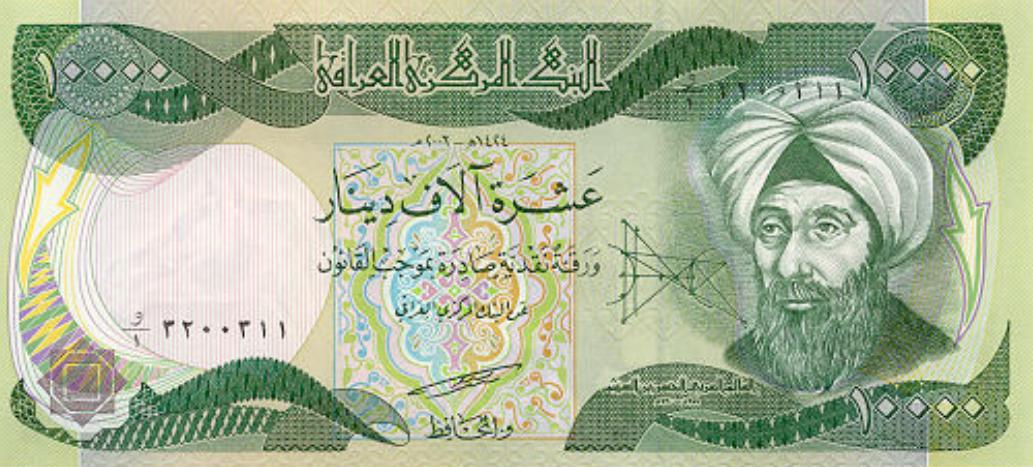
Al-Haitham, known in the West as Alhazen, is considered as the father of modern optics. Ibn al-Haitham was born in 965 C.E. in Basrah (present Iraq), and received his education in Basrah and Baghdad. He traveled to Egypt and Spain. He spent most of his life in Spain, where conducted research in optics, mathematics, physics, medicine and development of scientific methods.
Al-Haitham conducted experiments on the propagation of light and colors, optic illusions and reflections. He examined the refraction of light rays through transparent medium (air, water) and documented the laws of refraction. He also carried out the first experiments on the dispersion of light into colors. In detailing his experiment with spherical segments (glass vessels filled with water), he came very close to discovering the theory of magnifying lenses which was developed in Italy three centuries later. It took another three centuries before the law of sines was proposed by Snell and Descartes.
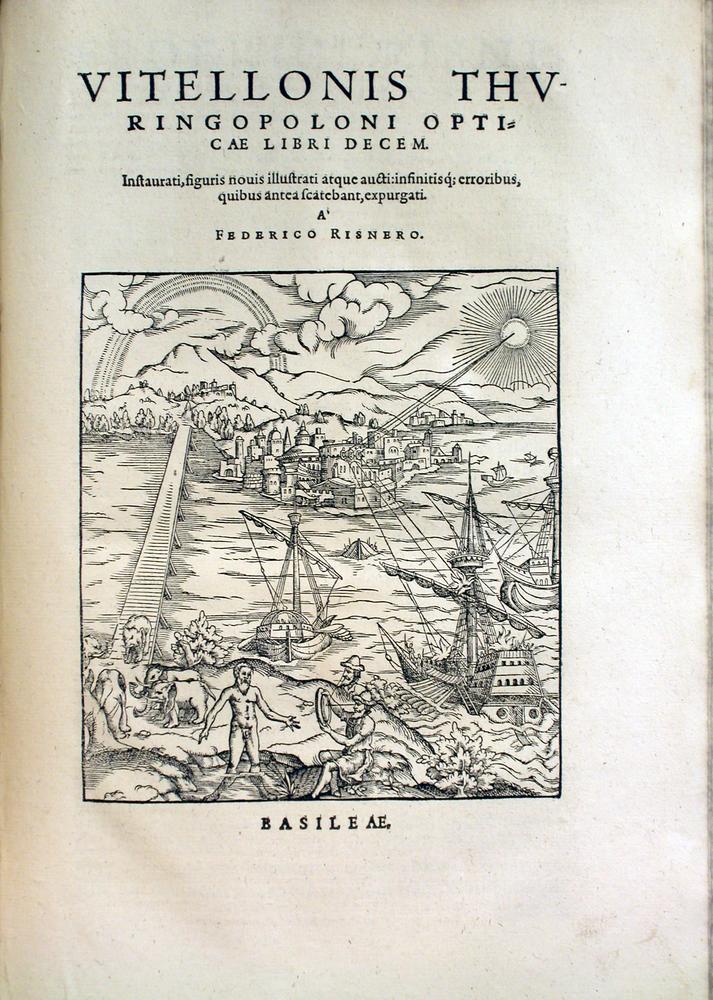
His book Kitab-al-Manazir was translated into Latin in the Middle Ages, as also his book dealing with the colors of sunset. He dealt at length with the theory of various physical phenomena such as the rainbow, shadows, eclipses, and speculated on the physical nature of light. Roger Bacon (thirteenth century), Pole Witelo (Vitellio) and all Medieval Western writers on Optics base their optical work primarily on Al-Haitham's 'Opticae Thesaurus.' His work also influenced Leonardo da Vinci and Johann Kepler. His approach to optics generated fresh ideas and resulted in great progress in experimental methods.
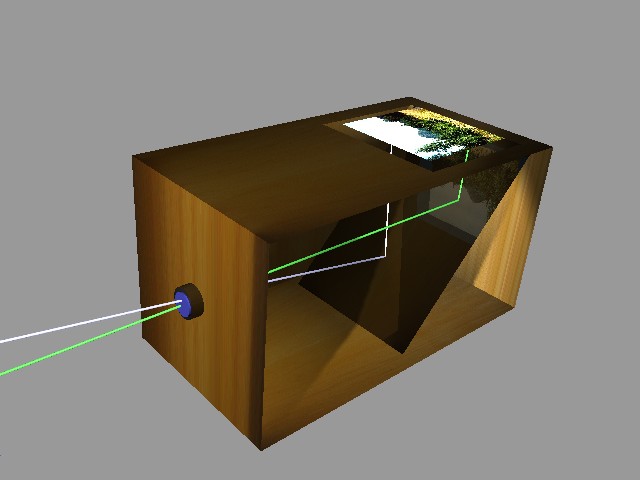
Al-Haitham was the first to describe accurately the various parts of the eye and gave a scientific explanation of the process of vision. He contradicted Ptolemy's and Euclid's theory of vision that the eye sends out visual rays to the object; according to him the rays originate in the object of vision and not in the eye. He also attempted to explain binocular vision, and gave a correct explanation of the apparent increase in size of the sun and the moon when near the horizon. He is known for the earliest use of the Camera Obscura.
In Al-Haitham's writings, one finds a clear explanation of the development of scientific method, the systematic observation of physical phenomena and their relationship to theory.
His research in optics focused on spherical and parabolic mirrors and spherical aberration. He made the important observation that the ratio between the angle of incidence and refraction does not remain constant and investigated the magnifying power of a lens. His catoptrics contains the important problem known as Alhazen's problem. It comprises drawing lines from two points in the plane of a circle meeting at a point on the circumference and making equal angles with the normal at that point. This leads to an equation of the fourth degree. He also solved the shape of an aplantic surface for reflection.
In his book Mizan al-Hikmah, Al-Haitham has discussed the density of the atmosphere and developed a relation between it and the height. He also studied atmospheric refraction. He discovered that the twilight only ceases or begins when the sun is 19o below the horizon and attempted to measure the height of the atmosphere on that basis. He deduced the height of homogeneous atmosphere to be 55 miles.
In mathematics, he developed analytical geometry by establishing linkage between algebra and geometry.
Al-Haitham wrote more than two hundred books, very few of which have survived. His monumental treatise on optics has survived through its Latin translation. During the Middle Ages his books on cosmology were translated into Latin, Hebrew and other European languages.

Ibn Al-Haytham and the Legacy of Arabic Optics

The year 2015 marks the 1000th anniversary since the appearance of the remarkable seven volume treatise on optics Kitab al-Manazir written by the Arab scientist Ibn al-Haytham. Born around a thousand years ago in present day Iraq, Al-Hasan Ibn al-Haytham (known in the West by the Latinised form of his first name, initially “Alhacen” and later “Alhazen”) was a pioneering scientific thinker who made important contributions to the understanding of vision, optics and light.
His methodology of investigation, in particular using experiment to verify theory, shows certain similarities to what later became  known as the modern scientific method. Through his Book of Optics (Kitab al-Manazir) and its Latin translation (De Aspectibus), his ideas influenced European scholars including those of the European Renaissance. Today, many consider him a pivotal figure in the history of optics and the “Father of modern Optics”.
Ibn al-Haytham was born during a creative period known as the golden age of Muslim civilisation that saw many fascinating advances in science, technology and medicine. In an area that spread from Spain to China, inspirational men and women, of different faiths and cultures, built upon knowledge of ancient civilisations, making discoveries that had a huge and often underappreciated impact on our world. 
UNESCO and the 2015 International Year of Light have partnered with the UK based organisation 1001 Inventions to launch a high-profile international educational campaign celebrating Ibn al-Haytham called '1001 Inventions and the World of Ibn al-Haytham'.
1001 Inventions and the King Abdulaziz Center for World culture in partnership with UNESCO and the International Year of Light 2015 will produce a short film on the work of 11th century scientist Ibn Al-Haytham: "1001 Inventions and the World of Ibn Al Haytham

Ibn Haythan known in the western world as Al Hazen, the great scientist of the end of the Xth century probably born in 965 in Basra (Persian gulf) from where he left for Cairo where he was officially posted as the officer and doctor of the ismailis Fatimid Kalifat.
He was a great astronomer, mathematician and physician. He wrote more than sixty books on different subjects. In all his work, the book on optics was a great revelation in the history of science. In his work he embraces all the subjects of the optics including the optical physiology.

His work includes a study on the reflection and refraction with realised experiments with the help of different mirrors (spherical, parabolics, cylindrical, concave and convex). A study on the magnifying glass, reasearch on shade, colors, rainbow and a discussion on light, that is the first philosophical scientific treaty on vision.
Optics in the western world before Alhazen
From the Vth century before J.C., a research between the eye and the seen object where the light as the principal actor was the main discussion because that light links the object to the eye. I today everyone adopts this theory without having a single thought about it and taking it as an evident reality, it is in fact a result of work and discussion of two thousand years.
The way the eye and the object communicated was one of the solutions another possible thought was a connection getting out of the eye and going to the object seen or from the object seen to the eye or a coexistence between those two things going from one to the other and vice versa.
All the ideas came into the discussion the first theory was a transmission from the eye to the object which was adopted by pythagoreans.
The atomic scientists were favorable to the transmission from the object to the eye. Empedocle (491-430 before J.C.) was the first one to conclude a two way transmission it is only a century later that a fourth theory came up (figure 1) with Aristot (384-322 before J.C.). At that time visual optic was dominated mostly by Greeks who extented their phylosophical ideas to vision.


For Plato (428-348 before J.C.) what he calls the divine fire or luminous force, gets out of the eye to detect the object. When the divine fire gets out of the eye it encounters the light sent by the object. It is the union of the two lights that gives the vision for the color vision it is the quantity of the divine fire which changes from one color to another.
Epicurus (341-280 before J.C.) denies the existence of rays trandsmitted by the eye to the object.
For Zeno (485-430 before J.C.) the rays transmitted by the eye felt the object.
At the alexandrian school with Euclid (3rd century before J.C.) and Ptolemee (2nd century before J.C.) the ideas of rays transmitted by the eye remains valid. Euclid says that the rays which are transmitted by the eye are made of luminous superimposed corpuscles contained in the area. For Ptomelee the eye sends visual rays. During the 3rd century, mathematical basis necessary to optics were elaborated by Euclid, Archimedes and Apollonius.
A conclusive contribution was brought by Galien (130-201 after J.C.) which described the structure of the eye. He brought the eye together with other sensorial organs of the human being. He brings up the optical nerve, which plays a role of a cavity through which a visual fluid flows from the brain. The ideas of Galien and Plato’s theory get together, that is a fluid flows to one eye and another fluid from the eye without getting out of it which makes the organe sensitive and ables it to be impressed by the first fluid. The structure of the eye strats to be involved even if a false idea which says that the cristallin plays a role.
All these ideas are going to be conclusive in the development of theories related to the vision mechanism and therefore on light. After Galien not much progress was made. Eight centuries later from synthesis on geometric and physiologic studies by Alhazen a general theory will come up. What will remain from the antique heritage is that the rays flow from the eye and goes to feel the object and the expression to have an evil eye.
Optics by Alhazen
Alhazen establishes optics on fundamental basis and physiology. He has undertaken the first reform on optics. He has extended his study by taking into consideration other phemonenon in his work Optica Thesurus.
In the first part of his work he says that direct and bright colors hurt the eye. With this idea, he stands by those who, admitted the existence of a light independent from the human being. His argument is that when the eye is in contact with bright light, they hurt and in fact when one observes the sun, he cannot see it because the excessive light hurt his eyes. And that is the same when one looks at a mirror well polished and illuminated by the sun. If the eye is placed in the sunbeam reflected by the mirror, that light that comes from the mirror to the eye the pain will be such that it will unable him to open his eyes.
He then concludes that if the eye suffers by something dazzling than we can believe that there is something flowing from the eye to the object because there is no reason to suffer when the eye is in contact with one object and not another but it is necessary to admit that there is something that flows from the object to the eye which has the capacity to reflect in a mirror concerning light, he says that any illuminated body by any kind of light, it flows from the light in all directions (figure 2).

Fig. 2 — Light flows to the object and goes back in all directions by that way is sent to each eye that faces it.
Alhazen continues with the same logic and says that when the eye is placed in front of an illuminated object, this will provide light to the external area of the eye. But it has been established that light has an impact on the eye and it is in the nature of the eye to feel the light and to suffer from it. The conclusion that follows is that the eye can see the object from the light that flows from it.

The second part of his work deals with experimentations related to visual sensitometry. He demontrates that a mild or excessive brightness or the interposition of flames under certain conditions make an object invisible or make its particularities more or less visible under good enlightment.
The third part of his work, based on various observations he shows that the tonality of colors varies with light.
In the fourth part, he describes the structure of the eye and in following chapter he discusses the vision mechanism. Vision is the result to rays coming from the object and going the eye. Here is the point where he differs from the grecoroman theory. But one problem remains to be solved which is how that light gets into the eye, gives form and structure to the object.
Alhazen comes up with one idea. He brings an element of sensitivity without any element of direction, the eye can see light and colors mixed and confused and an organized vision links one point of the object to one impressed point of the eye from the optical diagram of the eye of Galien and considering that the several different transparent layers are concentric, the crystalline at the centre of the eyeball where the essential of the visual faculties stands; Alhazen takes into consideration Euclid’s pyramidal perspective but draws it with rays going from various part of the object and flowing at the surface of the eye and therefore places the summit of the pyramid at the centre of the eye. Colors and different points of the object are spread in a regular way along the rays to the cornea and pupil. They get printed on the first layer of the crystalline. This picture in the same order, similar to the object is therefore in the eye with all the elements to realize a vision knowing the existence and the nervous structure of the retina why Alhazen admits that printing is made at the first layer of the crystalline? The answer to that question is evidence? It is due to the difficulty to get the rays through the crystalline.
He had discovered the darkroom and knew that image of a candle is reversed. If the image had to formed on the retina, it would necessarily be pictured inversely, therefore beyond the centre of the eye. The position of the retina picture is inverse.
Alhazen has resolved a problem long of 15 centuries which was to get into the pupil any reduced form of any seen object. He says that the object is formed before it gets inversed. He could get any explanation on the image being inversed that would satisfy. He gives up the idea of the retina being the organ of vision.
He thinks that his theories are valid, when he encounters difficulty he finds solutions, temporary solutions if he is not entirely satisfied.
This false problem on the interpretation of a physical inversed image being positionned rightly has been resolved by physiologists and philosophers of 19th century.
Alhazen continues his theory by explaining the existence of rays from the object is not sufficient. The eye has to be in the direction of the object in order to receive the rays. At this stage of his study, Alhazen had to explain how two organs gave an identical vision. He discovered that by covering one eye, he provoqued diplopia. His first conclusion was that images were formed in similars ways and that a message was transmitted by the crystalline and then to the optical nerves before getting to the chiasma. At that point a message merges which was lately interpreted by psychological facts and reason (figure 3).
Alhazen says that we receive 2 images which are double but perceived as one single image he demonstrate the unification process from physiological diplopia.
Out of his seven books, an entire one deals with optic illusion. He describes a series of experiences on visual field and visual intensity. His theory is based on mechanism. He builts a theoric light that flows in a staight line and reflects in mirrors and refracts on transparent surfaces. It follows a rectilinear mouvement without any fear for intersection with other lights in a diaphanous body. The light is spread in a very fast motion. The motion in a translucide body is quicker than in deep body. In fact in any translucide body, the light that passes through depends on the resistance of its structure.
A great conclusive contribution to Alhazen’s work was brought by geometers, persian and arab mathematicians as Khawarazmy, Neiziry (Anaritius), Alkindi, Sharafdin Tusi, Ibn Sahl, Kouhie, Suzi and all those who have worked on that matter before Alhazen.
His collaborators were not known and the credit of his work was given to him.
The final outcome of Alhazen’s work is more historical. He has imagined what is today a simple evidence. Alhazen created visual optics on solid basis with valid experimentations and calculations.
Kepler, six centuries later, accomplished the first reform on optics and scientist recognize Alhazen to be the creator of what is called today physiological optics.


The full name of our scientist is Abu Ali al-Hasan Ibn al-Hasan Ibn al-Haytham al-Basrî al-Misrî (965-1041). In medieval Europe, he was known as "Alhazen" (Latin form of "al-Hasan"). He was born in Basra, Iraq. He was a great mathematician, astronomer, physicist, and the founder of experimental science. He supported the results of his experiments with strong proofs. He began his scientific career in Iraq, where he envisaged the construction of a high dam on the river Nile near Aswan to regulate its waters. When the Fatimid Caliph al-Hakim (996-1021) heard about this project, he invited Ibn al-Haytham to Egypt, where firsthand observation convinced our scholar that such a construction was impossible. He then simulated madness and was put under house arrest until al-Hakim's death. After 1021, under the following Fatimid caliphs al-Zahir (1021-10367 and al-Mustansir (1036-1049), he recovered liberty and pursued his scientific activies.

Ibn al-Haytham was possibly the first to classify all even perfect numbers (i.e., numbers equal to the sum of their proper divisors) as those of the form 2k - 1(2k - 1) where 2k - 1 is a prime number. He also stated Wilson's theorem: If p is prime, then 1 + (p - 1)! is divisible by p (where "!" denotes the factorial function). It is called Wilson's theorem because of a comment by Waring in 1770 that the English mathematician John Wilson (1741–1793) had noticed the result. There is no evidence that Wilson knew how to prove it. It was Lagrange who gave the first known proof of the statement in 1771.
2. Introducing Ibn al-Haytham and his work
The number of written resources available in Turkish on one of the greatest scientists of all times, Ibn al-Haytham (Alhazen), is significantly limited and as such this work fills in a large gap by providing the readers with a wholesome text that sets out his major achievements and everlasting legacy. Ibn al-Haytham is renowned throughout the history of science as the ‘father of optics' for his brilliant contributions way ahead of his time which sometimes overshadow his many other important accomplishments, including the development of valuable experimental methods. The main purpose of this book is to introduce the life, works and scientific successes of "the greatest optician of all times" in eight detailed and comprehensive chapters.
In the first chapter of the book of Huseyin Gazi Topdemir, which outlines Ibn al-Haytham's growing devotion to science through time, Ibn al-Haytham is characterised as one of the main contributors to the development of science in the Classic Islamic World, highlighted by his significant efforts in acquiring and mastering the prominent contributions of Ancient Greek science and philosophy. Due to his father's high position within the government, he received a high quality education, allowing him to become exceptionally well in conceptual and practical sciences and earning him the title of engineer in his earlier years. He traveled to a number of places and carried on his observations and studies in several Islamic countries, further expanding his knowledge base and common understanding. One of the earliest projects he undertook upon the orders of the Fatimid Caliph in Egypt Al-Hakim is the construction of a barrier that would stop the Nile River from overflowing. Even though he was unsuccessful in achieving this, the reasons of this failure remaining obscure, the models he developed were quite extraordinary and involved fine engineering.
Huseyin Gazi Topdemir notes that Ibn al-Haytham spent a significant part of his life in Cairo copying scientific texts and earned his living by reproducing them. As a result, he had an enormous knowledge base and was directly aware of almost all previous scientific studies. In parallel, Ibn al-Haytham carried out imperative studies in optics but also made substantial findings in other scientific fields, including astronomy and geometry and has left behind a number of significant works. His most prominent publication was Kitab al-Manazir (The Book of Optics), one of the most original scientific text of all times. This book was published in a number of different languages starting with Latin and left an extraordinary impact on Middle Age Europe and onwards. It has been an important source of reference and inspiration for many scientists within the field of optics. In this book, Ibn al-Haytham successfully rejected well-established ancient beliefs by using creative thought and criticising the works and findings of his predecessors, establishing a bridge between Ancient Greek knowledge and Middle Age Latin Science. He developed a number of new theories by undertaking independent studies instead of using prior works as authority to provide basis and proof.
Hüseyin Gazi Topdemir states that Ibn al-Haytham demonstrated admirable courage and determination in deeply analysing the works of other highly regarded scientists like Aristotle, Euclid and Ptolemy and by being able to point out their mistakes. One of the main aspects which distinguished him from other scientists of his time was that he directed his focus to one specific field instead of keeping a wide array of study interests. Most of his studies in other fields were related to his optics studies and did not evolve around making new discoveries or providing further proof for a finding. For example, in investigating the refraction of light, he analysed the reasons behind the refraction of light in the atmosphere and as a result obtained the pre-requisite knowledge on astronomy. Another example of his optics related findings includes the discovery of the geometrical problem known as the Alhazen's problem which aimed to prove that light rays which approach the light axis parallel will meet at one point on the axis in dinted mirrors. The author explain this problem with this equation: H (x2-y2)-2Kxy+(x2+y2) (hy-kx)=0.
As a result of his keen focus on this field, he became the most prominent figure in the history of optics until the 17th century and his findings changed the science of optics radically.
The second chapter of the book entitled ‘Doctor Mirabilis' shows the influence of Ibn al-Haytham on well-known scientists following him. Topdemir puts forward that Roger Bacon, who was identified as a Doctor Mirabilis (Exceptional Scientist) of the Middle Ages obtained most of his ideas on light and sight from Ibn al-Haytham, like other 13th and 14th century researchers, including John Pecham and Witelo. All their works are full of references to Ibn al-Haytham's studies, especially to Kitab al-Manazir which aimed to expose all the characteristics of light through observational and experimental investigations and mathematical explanations, analysing the accumulated knowledge, problems and suggested solutions of the Old Ages. The author suggests that Ibn al-Haytham's works successfully achieved their purpose of presenting an understanding of the science of optics which was wholly true, independent of past authorities and based solely on experimental and mathematical inductions.
3. Ibn al-Haytham's intellectual legacy
In the third chapter, Topdemir suggests that studies made on the history of scientific development shows that scientific development was an activity that took place subsequently in between the East and the West throughout world history. He puts forward an interesting argument by suggesting that the high level interaction between different cultures resulting from science show that it is a field on which humanity unites. He asserts that by the 8th century, Muslims had established themselves as the intellectual leader of the world, acquiring the scientific and philosophical legacy of the past. This legacy was embraced by Muslim scholars who utilised the Arabic translations of ancient works to make fresh, original contributions. As such, he argues that it is not surprising for Ibn al-Haytham to have started his studies by an analysis of the knowledge inherited from the Greeks. However he also benefited greatly from the culture of scientific research and development existent in the Islamic world during his times. Topdemir links Ibn al-Haytham's success to two main dimensions, including the application of existent methods to new fields and enhancement of factual knowledge through a process of analysis and secondly on developing new experimental processes.

The author also mentions treatises written by other Muslim scholars before Ibn al-Haytham, including the Banu Musa Brothers' Kitab al-Hiyal which included immaculate designs and mechanisms still applicable today. He emphasises that Ibn al-Haytham was born into a technologically enhanced society and a culture which embraced scientific thought. Another example provided is that of Thabit Ibn Qurra (829-901) who was one of the foremost mathematicians of his times and successfully translated many Greek works into Arabic, also using them as a valuable source in his findings. By employing these reputable models, especially those of the well-established scientist Al-Kuhi, Ibn al-Haytham was able to develop a geometrical concept on quadrilaterals to determine the outcomes of applying different forces to certain objects. Ibn al-Haytham was further influenced by Ibn Sahl who arguably developed the rule on the refraction of light in his studies in geometric optics.
4. Reflexions on scientific methodology
The in his fourth chapter of the book authored by Topdemir shows that Ibn al-Haytham also developed pioneering concepts on the nature and methods of science and provides a few worthy examples. He states that Ibn al-Haytham was adopted a holistic approach to science and to correctly depict scientific methodology in terms of classical scientific understanding. He was also one of the first scholars of his times to exhibit a modern research approach by focusing on one specific area and to use experimentation as both a tool for discovery and verification. He had a clear understanding of the importance of mathematics, more specifically of geometry, in scientific explanation and demonstration as evident from his quadratic theorem. In his studies, he did not only provide experimental proofs but also made available causal explanations. The author also presents simple details of his fundamental works and the operations of his models giving citations from Ibn al-Haytham's various works to highlight the everlasting effect and relevance of his methods and thoughts. He allows the reader to see that the methodologies and practices Ibn al-Haytham developed were generally at a higher level than those following him like Francis Bacon in the 16th century. It is obvious from his works that he not only valued the observational, experimental and mathematical aspects of science, but at the same time, highly regarded its historical development.
Further, Topdemir argues that Ibn al-Haytham also used the techniques of induction and deduction in an acute and careful manner in the light of experimental determination. According to Ibn al-Haytham, science is the activity of expressing facts consistent within concepts under a mathematical light attained from observation and experimentation. As pointed out by the author, this is very similar to the modern day understanding of science. Ibn al-Haytham had suggested a two phase system of arriving at fundamental data, made up of analysis and synthesis and has identified lack of satisfactory observations as the main reason behind wrongful findings which was a common reason for failure in problem solving in Middle Ages optics. He also successfully pointed out the significant problem of generalisation from insufficient data and tried to overcome this by very elaborate and detailed experiments. Consequently, Topdemir argues that even though he lived in the 11th century, Ibn al-Haytham implemented investigations and practices achievable by the use of modern age methods.
5. The mathematical investigation of the world In the fifth part of the book, the author gives an explanation of the relationship between geometry and optics as understood in those times and outlines the important respects of Ibn al-Haytham's work in order to allow us to appreciate the extent of his capabilities and the significance of his studies. Ibn al-Haytham also referred largely to the works of other scientists in his fields using them as a resource but also improving on the ideas presented. He undertook to complete Apollonius' work on the conics, the eighth book of which was missing, by analysing the first seven articles and determining the missing content through the method of analysis, synthesis and renewal. He also criticised and amended some of the works of Euclid on geometrical drawing.
The sixth chapter discusses Ibn al-Haytham's astronomical studies and shows that he also had an interest in this field. His book Fi Hay'at al-'alam (On the Configuration of the World) had a significant impact on the astronomers of the Middle Ages and the Renaissance, especially on Peuerbach's book The New Planet. The author again provides some basic information about the development of astronomical models and the continuous change in astronomical theory throughout history to better enable readers to understand the context and impact of Ibn al-Haytham's studies. He also effectively utilises explanatory images, diagrams and passages as well as depictions of the mentioned scientists to maintain the attention and certify the understanding of the reader throughout the book.
The seventh chapter, titled ‘Ex Oriente Lux' (The Light Comes from the East), suggests that the truthfulness of this statement has been definitively reflected through Ibn al-Haytham's life and works. The author applauds his success in putting forward a wholesome optics theory, overcoming the confusion and lack of clarity associated with this science in those time by utilising fundamental principles and significant techniques. After dismissing the emission theory which suggested that the eye emitted the light rays, Ibn al-Haytham moved from the assumption that light proceeded to the eye from each point on an object to develop his own basic theory. Regardless of a few downfalls, his optics theories were exceptionally successful and were accepted as authority in both the Eastern and Western worlds until the 17th century. Topdemir asserts that the main factor behind this success was his courage in using creative thought and producing independent models, instead of accepting existent theories on their face. He developed many original notions about the nature of light rather than simply refuting previous studies and extensively used experiments to prove his ideas. The author suggests that his book even today is a valid source of clear and comprehensible information on the rules and developments of optics, further signifying the scope and success of his studies.

The final chapter starts with the details of the knowledge sovereignty held by the Muslims over the Medieval Era. It is stated that where the Muslims were making many original and unique contributions to science, the popular studies of the West were simply encyclopaedic works. According to Topdemir, Muslims inspired the renewal of the tradition of scientific thought in Europe. In his final analysis of Ibn al-Haytham's influence, the author points out that the main indicator of a scientist's authoritative power in his field is not only the directive force of his thoughts and ideas but at the same time, the unhesitant embracement of his mistakes of those following him. Ibn al-Haytham's Kitab al-Manazir had a large influence on the study of optics in his era and specifically inspired many scientists including Bacon, Pecham and Witelo. It is clear that until the 17th Century, all the main arguments, technical framework, controversial aspects and suggested solutions in the field of optics were advanced by Ibn al-Haytham. The author notes that the enormous value extended to scientific thought and scholars in the Middle Age Islamic World also had a substantial role in Ibn al-Haytham's success. As a result, his influence was not limited to his time or the Western world but also had a large impact on the studies of following Islamic researchers like Kamal Al-Din al-Farisi.
6. Concluding remarks
Overall, the book presents a fair and balanced summary of Ibn al-Haytham's studies, focusing on his major achievements. The basic scientific explanations on relevant issues provided by the author raise the understanding of readers while giving them background information to better comprehend the extent of Ibn al-Haytham's successes. The book is well referenced and contains a large number of explanatory diagrams, images, posters and helpful citations from Ibn al-Haytham's works. However it lacks information on Ibn al-Haytham's life and practices, which might set a better light on his aspirations and determination in scientific research and discovery. It is easy to read and follow and as a whole provides reliable and noteworthy details about a great man who should be taken as an example by any student of science.


In the Genius Arab Civilization, A. I Sabra stated, "Ibn al Haytham's most important contribution were in the fields of optics, mathematics, and astronomy. His most important single work is the comprehensive Kitab al-Manazir (the Book of Optics). Until the revival of optics in Persia, towards the end of thirteenth century, Ibn al-Haytham was mainly known to the Islamic world as mathematician and as an astronomer, but his best-known and most influential work in Europe was the Optics. It was largely on these bases of his book that George Sarton described Ibn al-Haytham as "the greatest Muslim physicist and one of the greatest students of optics of all times." Other optical subjects of Ibn al-Haytham include: "On the light of the Moon, that argues that the moon shines like a self luminous object, though its light is borrowed from the Sun; On the Halo and Rainbow; On Spherical Burning Mirrors; On Paraboloidal Burning Mirrors; and On the Shape of eclipse, which examines the camera obscure phenomena.


Abu Ali Muhammad al-Hassan ibnu al-Haitham (Bahasa Arab:ابو علی، حسن بن حسن بن الهيثم) atau Ibnu Haitham (Basra,965 - Kairo 1039), dibarat lebih dikenal dengan namaAlhazen. Adalah seorang ilmuwan Islam yang ahli dalam bidang sainsfalakmatematikageometripengobatan, dan filsafat. Ia banyak pula melakukan penelitian mengenaicahaya, dan telah memberikan banyak inspirasi pada ahli sains barat, seperti Roger Bacon, dan Kepler dalam menciptakan mikroskop serta teleskop..
Sejarah
Masa ilmuwan-ilmuwan Islam
Sejarah telah membuktikan betapa dunia Islam telah melahirkan banyak sarjana dan ilmuwan yang sangat hebat dalam bidang falsafahsainspolitik, kesusasteraan, kemasyarakatan, agama, pengobatan, dan sebagainya. Salah satu ciri yang dapat dilihat pada para tokoh ilmuwan Islam ialah mereka tidak sekedar dapat menguasai ilmu tersebut pada usia yang muda, tetapi dalam masa yang singkat dapat menguasai beberapa bidang ilmu secara bersamaan.
Walaupun Haytham lebih dikenal dalam bidang sains dan pengobatan, tetapi dia juga ahli dalam bidang agamafalsafah, dan astronomi. Salah seorang dari tokoh tersebut ialahIbnu Haitham atau Abu All Muhammad al-Hassan ibnu al-Haitham.
Perjalanan hidup
Dikalangan cendikiawan Barat, Haytham dikenal dengan nama Alhazen. Ibnu Haitham dilahirkan di Basrah pada tahun 354H atau 965 Masehi. Ia memulai pendidikan awalnya di Basrah sebelum diangkat menjadi pegawai pemerintah ditempat kelahirannya. Setelah beberapa lama bekerja dipemerintahan, Haytham pergi ke Ahwaz dan Mesirdiperjalanan ke Ahwaz, Haytham menghasilkan beberapa karya tulis yang luarbiasa.
Kecintaannya kepada ilmu pengetahuan, telah membawanya berhijrah ke Mesir. Selama di Mesir Haytham melakukan beberapa penyelidikan mengenai aliran Sungai Nil serta menyalin buku-buku mengenai matematika dan falak. Tujuannya adalah untuk mendapatkan uang cadangan dalam menempuh perjalanan menuju Universitas Al-Azhar.
Haytham telah menjadi seo­rang yang mahir dalam bidang sains, falak, mate­matika, geometri, pengobatan, dan falsafah. Tulisannya mengenai cara kerja mata manusia, telah menjadi salah satu Referensi yang penting dalam bidang kajian sains di Barat. Teorinya mengenai pengobatan mata masih digunakan hingga saat ini diberbagai Universitas di seluruh dunia.
Karya dan penelitian[
Sains
Ibnu Haitham merupakan ilmuwan yang gemar melakukan penyelidikan. Penyelidikannya mengenai cahaya telah memberikan ilham kepada ahli sains barat seperti Boger, Bacon, dan Kepler mencipta mikroskop serta teleskop. Ia merupakan orang pertama yang menulis dan menemukan berbagai data penting mengenai cahaya.
Beberapa buah buku mengenai cahaya yang ditulisnya telah diterjemahkan ke dalam bahasa Inggris, antara lain Light dan On Twilight Phenomena. Kajiannya banyak membahas mengenai senja dan lingkaran cahaya di sekitar bulan dan matahari serta bayang-bayang dan gerhana.
Menurut Ibnu Haitham, cahaya fajar bermula apabila mata­hari berada di garis 19 derajat di ufuk timur. Warna merah pada senja pula akan hilang apabila mata­hari berada di garis 19 derajat ufuk barat. Dalam kajiannya, dia juga telah berhasil menghasilkan kedudukan cahaya seperti bias cahaya dan pembalikan cahaya.
Ibnu Haitham juga turut melakukan percobaan terhadap kaca yang dibakar, dan dari situ ditemukanlah teori lensa pembesar. Teori itu telah digunakan oleh para ilmuwan di Itali untuk menghasilkan kaca pembesar yang pertama di dunia.
Yang lebih menakjubkan ialah Ibnu Haitham telah menemui prinsip isi padu udara sebelum seorang ilmuwan yang bernama Trricella yang mengetahui perkara itu 500 tahun kemudian. Ibnu Haitham juga telah menemukan kewujudan tarikan gravitasi sebelum Issaac Newton mengetahuinya. Selain itu, teori Ibnu Hai­tham mengenai jiwa manusia sebagai satu rentetan perasaan yang bersambung-sambung secara teratur telah memberikan ilham kepada ilmuwan barat untuk menghasilkan wayang gambar. Teori dia telah membawa kepada penemuan film yang kemudiannya disambung-sambung dan dimainkan kepada para penonton sebagaimana yang dapat kita lihat pada masa kini.

Filsafat]
Selain sains, Ibnu Haitham juga banyak menulis mengenai falsafah, logik, metafizik, dan persoalan yang berkaitan dengan keagamaan. Ia turut menulis ulasan dan ringkasan terhadap karya-karya sarjana terdahulu.
Penulisan falsafahnya banyak tertumpu kepada aspek kebenaran dalam masalah yang menjadi pertikaian. Padanya pertikaian dan pertelingkahan mengenai sesuatu perkara berpunca daripada pendekatan yang digunakan dalam mengenalinya.
Dia juga berpendapat bahawa kebenaran hanyalah satu. Oleh sebab itu semua dakwaan kebenaran wajar diragui dalam menilai semua pandangan yang sedia ada. Jadi, pandangannya mengenai falsafah amat menarik untuk disoroti.
Bagi Ibnu Haitham, falsafah tidak boleh dipisahkan daripada matematik, sains, dan ketuhanan. Ketiga-tiga bidang dan cabang ilmu ini harus dikuasai dan untuk menguasainya seseorang itu perlu menggunakan waktu mudanya dengan sepenuhnya. Apabila umur semakin meningkat, kekuatan fizikal dan mental akan turut mengalami kemerosotan.
Karya
Ibnu Haitham membuktikan pandangannya apabila dia begitu ghairah mencari dan mendalami ilmu pengetahuan pada usia mudanya. Sehingga kini dia berhasil menulis banyak buku dan makalah. Di antara buku hasil karyanya:
1.     Al'Jami' fi Usul al'Hisab yang mengandungi teori-teori ilmu metametik dan metametik penganalisaannya;
2.     Kitab al-Tahlil wa al'Tarkib mengenai ilmu geometri;
3.     Kitab Tahlil ai'masa^il al 'Adadiyah tentang algebra;
4.     Maqalah fi Istikhraj Simat al'Qiblah yang mengupas tentang arah kiblat bagi segenap rantau;
5.     M.aqalah fima Tad'u llaih mengenai penggunaan geometri dalam urusan hukum syarak dan
6.     Risalah fi Sina'at al-Syi'r mengenai teknik penulisan puisi.
Sumbangan Ibnu Haitham kepada ilmu sains dan filsafat amat banyak. Kerana itulah Ibnu Haitham dikenali sebagai seorang yang miskin dari segi material tetapi kaya dengan ilmu pengetahuan. Beberapa pandangan dan pendapatnya masih relevan hingga saat ini.
Walau bagaimanapun sebahagian karyanya lagi telah "dicuri" oleh ilmuwan Barat tanpa memberikan penghargaan yang patut kepada dia. Tapi sesungguhnya, barat patut berterima kasih kepada Ibnu Haitham dan para sarjana Islam karena tanpa mereka kemungkinan dunia Eropa masih diselubungi kegelapan.

Kajian Ibnu Haitham telah menyediakan landasan kepada perkembangan ilmu sains dan pada masa yang sama tulisannya mengenai falsafah telah membuktikan keaslian pemikiran sarjana Islam dalam bidang ilmu tersebut yang tidak lagi terbelenggu oleh pemikiran filsafat Yunani.